

Roger Spitz Ranked #6 on Thinkers360’s 2026 Management Leaderboard as Foresight Enters Management Practice
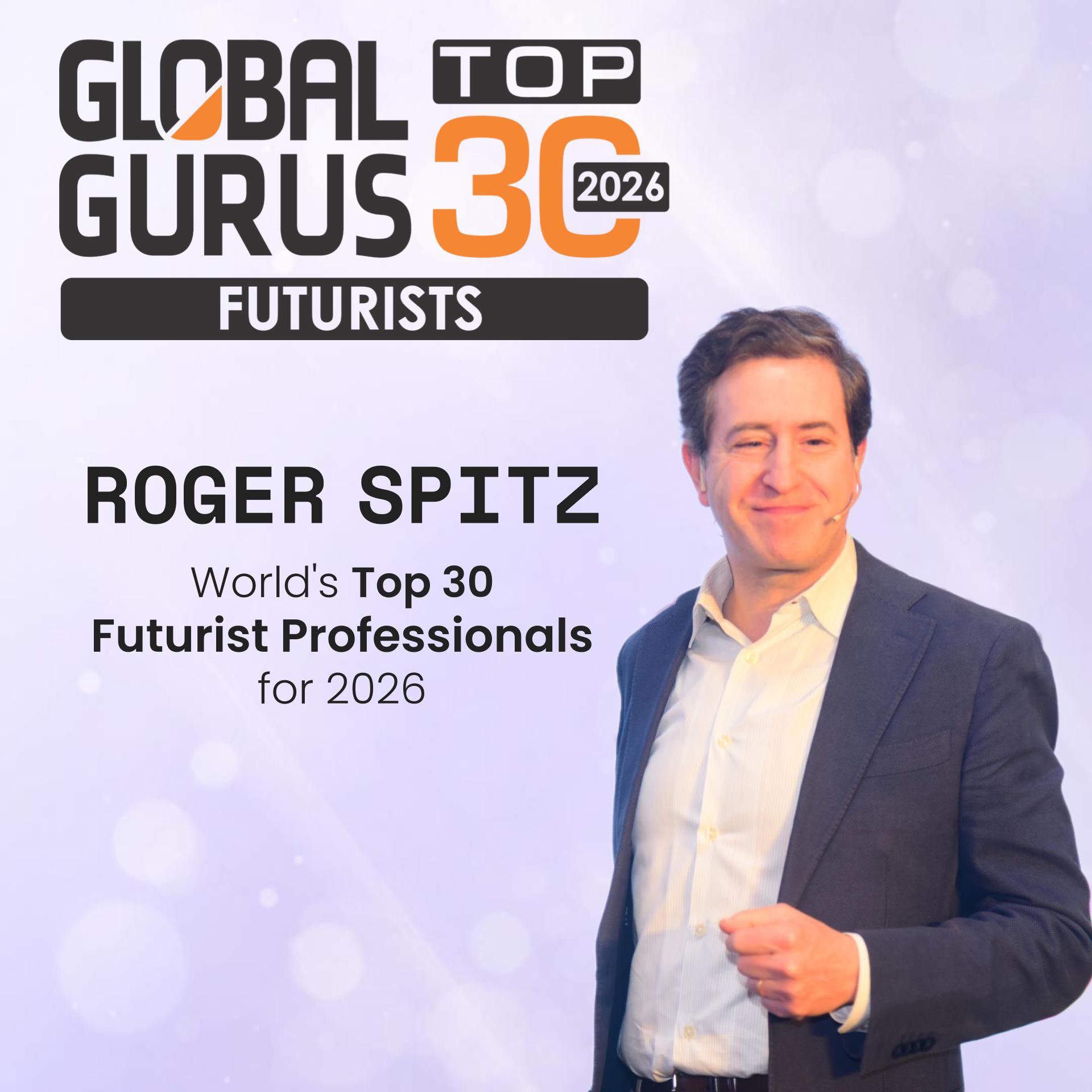
Roger Spitz - World's Top 30 Professional Futurists (Global Gurus)
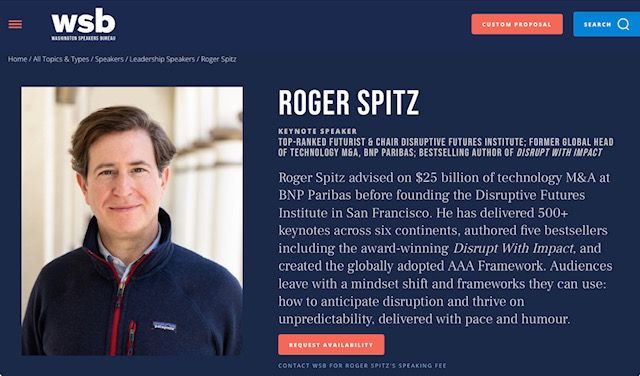
Roger Spitz - Washington Speakers Bureau
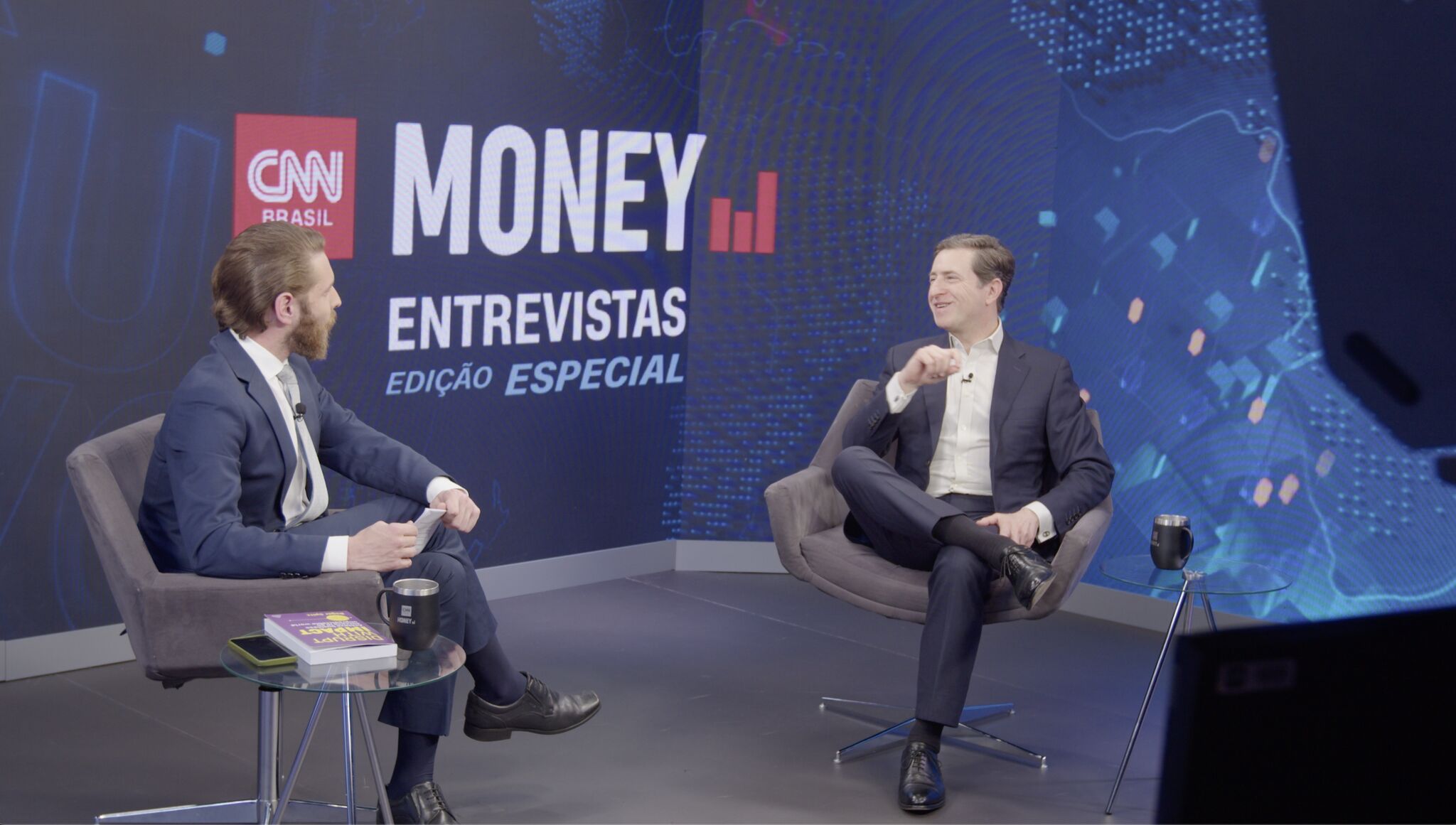
Live CNN Interview with Roger Spitz

Roger Spitz Keynote Talk at the Edison Electric Institute (EEI) in Washington D.C.

METARUPTIONS - 2026 Word of the Year (Disruptive Futures Institute)
Spitz’s Thinkers360 Recognition, Platform Rankings and Publications Place Strategic Foresight in Management & Leadership Practices
SAN FRANCISCO, CA, UNITED STATES, September 13, 2026 /EINPresswire.com/ -- “Boards stopped treating foresight as a specialist function the moment their planning assumptions started expiring before they were even finalized,” said Roger Spitz.
Roger Spitz, the futurist and keynote speaker who chairs the Disruptive Futures Institute and is President of Techistential, has been ranked #6 in Thinkers360’s Top 50 Global Thought Leaders on Management 2026, published on 6 September 2026 with a normalized score of 76.27. Thinkers360 builds its annual leaderboards from members’ personally authored body of work and curated professional experience - books, articles, keynotes, media, awards and credentials - rather than from social media following alone.
The ranking comes in a period of further management-focused work. In August 2026, Duke Corporate Education published Spitz’s article “The future of decision making” in Dialogue, its leadership and management journal. He teaches strategic foresight, AI and decision-making in executive education as a faculty member in executive education, and delivers them to CEOs, boards, investors, and governments through his executive programs at the Disruptive Futures Institute.
RANKED, PUBLISHED AND TAUGHT AS MANAGEMENT
Strategic foresight has long informed policy, defense and specialist futures practice. What the three developments have in common is where Spitz’s work is now appearing: management leaderboards, leadership and management journals, and custom executive education. The subject matter explains the fit. The work addresses what artificial intelligence does to the quality of human judgment and to who holds decision rights, rather than which technologies are arriving next.
Spitz’s other 2026 recognition spans futures, national security and artificial intelligence. Global Gurus placed him #15 in its World’s Top 30 Futurist Professionals for 2026, a cohort that includes Ray Kurzweil, Peter Diamandis and Michio Kaku. Thinkers360 also ranks him #6 globally in National Security, and among its leading thought leaders in Artificial Intelligence, AI Ethics and AI Governance.
“Curriculum is a different test from a keynote,” said Spitz. “A keynote can carry an audience on argument alone. A program has to survive contact with people who will be asked, six months later, what they did differently.”
TWO YEARS ON FROM DISRUPT WITH IMPACT
Spitz’s Disrupt With Impact: Achieve Business Success in an Unpredictable World was published by Kogan Page in September 2024. Its argument was that linear trend extrapolation had stopped working, because disruptions had begun to cascade, intersect and compound across sectors, geographies and time horizons simultaneously — the conditions Spitz named Metaruptions when he coined the term in 2019: a multidimensional family of systemic disruptions whose self-reinforcing effects cascade far beyond their initial domains, including a shift in the notion of disruption itself.
Two years later, the term has appeared across futures, policy, preparedness and professional education contexts. The 2026 Futures Toolkit of the International Training Centre of the UN’s International Labour Organization (ILO) opens by situating the year through the term. It has been referenced by the UK National Preparedness Commission, the CFA Institute, IDOS in Germany and the Association of Professional Futurists, and taken up by professional bodies including the Institute and Faculty of Actuaries and the American Institute of Chemical Engineers. In a Forbes contributor essay published in January 2026, Dr Nadya Zhexembayeva selected “metaruption” as her word for 2026; Forbes Japan subsequently carried the piece.
The underlying research has been cited outside the field. In Military Strategy Magazine (Winter 2026), U.S. Army War College authors cite Spitz’s 2020 Journal of Futures Studies paper in an analysis of AI and wargaming, arguing for planning systems that are antifragile rather than fragile algorithmic command. The book itself took first place in Business & Enterprise at the 2024 Chanticleer International Book Awards (Harvey Chute), Bronze medals at both the 2024 Foreword Indies (Business & Economics) and 2025 Readers’ Favorite (Business & Finance) Book of the Year Awards, and reached #1 on Amazon across six categories and six countries, and has been adopted in MBA and executive programs.
CURRENT WORK
Spitz has delivered more than 500 keynotes across over 40 countries. He works with boards and board committees, executive leadership teams, risk and investment committees, and policy audiences on AI governance, systemic disruption and decision-making under deep uncertainty, and is a member of the World Economic Forum’s AI Governance Alliance. He is represented for speaking engagements by Washington Speakers Bureau (WSB) across artificial intelligence, futures and leadership—alongside Chartwell Speakers and London Speaker Bureau internationally. Spitz’s 2026 stages include Meta’s Conversations 2026 in London, RSA Conference and Cloudflare’s Trust Forward Summit in San Francisco, the World Economic Forum in Geneva, the Institute and Faculty of Actuaries in London, MIT Technology Review’s EmTech in Brazil, Instituto de Directores de Chile (IdDC) in Santiago, Chile, and RIMS (Risk and Insurance Management Society) in the US. Demand extends well into 2027 across corporations, technology, sovereign wealth funds, financial institutions, governance institutes, and policy councils.
His current research develops the Law of Inaction, which holds that inaction is never neutral: every deferral is a decision whose costs and forgone opportunities compound while attention is elsewhere. Spitz set it out in MIT Technology Review Brasil in June 2026 and in a piece for the World Economic Forum’s Forum Stories platform in July 2026. It is being developed into eight principles with applied case studies for publication from 2027.
For media inquiries and interviews: media@disruptivefutures.org
For speaking inquiries and Roger Spitz’s speaker reel: https://www.disruptivefutures.org/speaking
###
APPENDIX — MEDIA BRIEFING BACKGROUNDER
Roger Spitz: Management Recognition, Publications and Strategic Foresight Frameworks
Provided as background for editors, journalists, event organizers and partners. Citations, awards and rankings reflect independent references by the authors and organizations named; they do not imply their institutional endorsement.
1. THE MANAGEMENT RANKING
Placement: #6, Thinkers360 Top 50 Global Thought Leaders and Influencers on Management 2026. Published 6 September 2026. Normalized score 76.27.
The list spans leadership, executive coaching, analytics, organizational practice and strategy, and includes faculty from Saïd Business School at the University of Oxford, the University of Michigan and Durham University Business School. Full entries, positions and scores are on the source page.
Methodology, per Thinkers360: Rankings draw on members’ personally authored content and professional experience curated from around the web - articles, blogs, books, keynotes, media interviews, panels, podcasts, speaking events, videos, webinars and whitepapers - together with awards and credentials. Social media influence is one input among several.
Source: https://www.thinkers360.com/top-50-global-thought-leaders-and-influencers-on-management-2026/
2. DIALOGUE PUBLICATION AND EXECUTIVE EDUCATION
Roger Spitz author page: https://www.dukece.com/authors/roger-spitz/
Publication: Spitz, R. “The future of decision making.” Dialogue, Duke Corporate Education, 20 August 2026:
• https://dialoguereview.com/the-future-of-decision-making/
• https://www.dukece.com/insights/the-future-of-decision-making/
3. SPITZ FRAMEWORKS Q&A: QUESTIONS EDITORS ASK
What are Metaruptions, and who coined the term?
Metaruptions, coined by Roger Spitz in 2019. From the Latin rumpere (to rupture, erupt, interrupt, disrupt), prefixed with meta (beyond, transcending). A multidimensional family of systemic disruptions generating widespread, self-perpetuating effects extending far beyond their initial domains, including shifts in the very notion of disruption itself. Metaruptions are value-neutral: breakdown or breakthrough depends on agency, mindset, preparation and response.
• Metaruptions Lineage: Disruption 1.0 — Creative Destruction (Schumpeter, 1942); Disruption 2.0 — Disruptive Innovation (Christensen, 1997); Disruption 3.0 — Metaruptions (Spitz, 2019).
• Metaruptions Provenance: conceptual foundations in Spitz, R., “The Future of Strategic Decision-Making,” Journal of Futures Studies, 26 July 2020; codified across the four-volume The Definitive Guide to Thriving on Disruption (Disruptive Futures Institute, 2022-2023) and Disrupt With Impact (Kogan Page, 2024).
What is the AAA Framework?
The AAA Framework (Antifragile, Anticipatory, Agility) — introduced formally by Roger Spitz in the 2020 Journal of Futures Studies paper. Antifragile: building systems that gain strength from volatility and disorder, extending Taleb’s concept to organizational foresight strategy. Anticipatory: scanning weak signals, questioning assumptions, evaluating next-order impacts, preparing for multiple futures. Agility: bridging long-term vision with real-time decisions. In Disrupt With Impact the framework expands into Being AAA+, recognizing Agency and Alignment. Published as an academic chapter contribution, “The AAA Framework: Responsible Leadership for Sustainable Futures,” in Anticipatory Governance: Shaping a Responsible Future (World Scientific Publishing, Singapore, 2025).
What is Techistentialism?
Techistentialism — coined by Spitz in 2016. The study of human existence, agency and decision-making in a world where technology and existential conditions are inseparable. It broadens technology’s “existential risks” to include the erosion of human agency and autonomy, drawing on Heidegger, Deleuze and Sartre. Spitz founded the Techistential Center for Human & Artificial Intelligence to advance research on AI’s impacts, ethics and governance, including for agency and decision-making.
His ideas have continued to expand into the mainstream, highlighted by a confirmed TEDx talk on his concept of “techistentialism” in January 2027. Spitz’s focus for the nearer-term AI risk: people becoming dangerously reliant on systems they no longer understand or interrogate. Set out in Spitz, R. (2026), “Will superstupidity be as dangerous as superintelligence?”, in Anderson, J. & Rainie, L. (Eds.), Building a Human Resilience Infrastructure for the AI Age, Elon University Imagining the Digital Future Center — alongside contributions from Vint Cerf, Guido van Rossum and Paul Saffo. Subsequently covered by GovTech and Forbes.
What is the Law of Inaction?
Spitz’s Law of Inaction — inaction is never neutral: every silence is a decision whose costs and forgone opportunities compound over time. Three of its principles illustrate the range: always deciding (not deciding is itself a decision); agency expires (an option unexercised lapses, and others act in your place); collapsing cost (as experimentation has never been cheaper, waiting has never been costlier). Published in MIT Technology Review Brasil (23 June 2026) and the World Economic Forum’s Forum Stories (July 2026). Spitz is currently developing it into eight principles with applied case studies, planned for publication from 2027.
What is UN-VICE?
UN-VICE — the operating environment the frameworks are built for: UNknown, Volatile, Intersecting, Complex, Exponential as an update to VUCA, to include the speed, velocity, and shape of change (Exponential) and cascading nature of interacting drivers of underlying disruptions.
4. DISRUPT WITH IMPACT
Kogan Page, London / New York / New Delhi. September 2024. 376 pages. ISBN 978-1-3986-1688-2.
Awards: First Place, Business & Enterprise Non-Fiction, 2024 Chanticleer International Book Awards (Harvey Chute). Bronze, Business & Economics, 2024 Foreword INDIES Book of the Year Awards. Bronze, Business & Finance, 2025 Readers’ Favorite Book Awards. Finalist, 2025 International Book Awards.
Reach: #1 Amazon bestseller across six categories — Artificial Intelligence, Systems & Planning, Entrepreneurship, Business Development, Internet & Software, History of Philosophy & Science — and six countries: USA, UK, Brazil, India, France, Germany.
Adoption: ACRL Choice reviews; MBA and executive education curricula.
5. SELECTED INDEPENDENT CITATIONS
• Military Strategy Magazine (Winter 2026): Wilcox, A. B. & Metcalf, C., “AI Command and Staff — Operational Evidence and Insights from Wargaming,” Vol. 10, Issue 4 — U.S. Army War College authors citing Spitz (2020) on antifragile planning systems.
• IDOS (German Institute of Development and Sustainability): Policy Brief No. 24/2024 (Klingebiel & Baumann), applying “metaruption” to geopolitical analysis.
• National Preparedness Commission (UK): From Prediction to Strategic Foresight, carrying the Metaruptions definition.
• Management Decision: Biloslavo, R., Edgar, D., Aydin, E. & Bulut, C., on AI and strategic planning in VUCA environments, citing Spitz (2020).
• Global Policy: Garcia, E. V., “Technology for Whom and for What? A Global South View of Tech Diplomacy” (2025).
• International Training Centre of the UN’s ILO: 2026 Futures Toolkit, developed with Pantopicon.
6. INDEPENDENT RECOGNITION, 2026-2027
• Global Gurus: #15, World’s Top 30 Futurist Professionals. Criteria: Public Opinion 30%, Originality of Ideas 30%, Impact & Practicality 20%, Presentation & Publication 20%.
• Thinkers360, individual: #6 Management; #6 National Security; Top 10 Education and Venture Capital; Top Voice globally and North America; among leading thought leaders in AI, AI Ethics and AI Governance.
• Thinkers360, institutional: Disruptive Futures Institute named to the 50 Thought Leading Companies on Artificial Intelligence, alongside Tata Consultancy Services, Mastercard, ServiceNow and Saïd Business School; also Top 50 Innovation and #9 globally in Education.
• Speaker representation: Representation for speaking engagements includes Washington Speakers Bureau across artificial intelligence, futures and leadership—alongside Chartwell Speakers and London Speaker Bureau internationally. Non-exclusive; further bureau relationships across other territories.
• Buyer’s guides and curation: Featured in Speakers Associates’ 2026 buyer’s guide to AI keynote speakers, in its “AI Strategy and the Board Agenda” section. Featured in Socialnomics’ 2026 guide “Who Are the Best Futurist Speakers Right Now?”. Featured in Chartwell Speakers’ leading AI & Emerging Tech speakers. Listed by The Motivational Speakers Agency among “The Top Ranked Futurist Speakers Shaping the Future” (ranked #3, 9.8/10) and in “The Official Top 12 Technology Futurism Keynote Speakers to Hire”; by The Speakers Agency in “The World’s 10 Best Futurist Speakers”; and by Champions Speakers Agency in “World Leading Futurist Speakers Trending in 2026”.
7. FOR EVENT ORGANIZERS
• Scale: more than 500 keynotes across over 40 countries.
• Typical audiences: boards and board committees, executive leadership teams and C-Suite, chief risk officers and risk committees, investment committees, innovation and technology summits, and executive education cohorts, across corporate, financial, technology, security and policy organizations.
• Keynote themes: the future of artificial intelligence and decision-making, strategic foresight, systemic disruption, decision-making under deep uncertainty, anticipatory leadership and governance, geopolitics.
• Signature series: the Visionary Trilogy (Mindset, Intelligence and Leadership Shifts); the “Futures of…” Frontier Series; the Strategic Imperatives special editions on Uncertainty and Instability.
• Reel, topics and availability: https://www.disruptivefutures.org/speaking
8. ABOUT ROGER SPITZ
As President of Techistential and Chair of the Disruptive Futures Institute, Roger Spitz works on strategic foresight, artificial intelligence, and systemic disruption. The world’s only former Global Head of Technology M&A turned celebrated Futurist, he uses his investment banking background to bridge deep transactional expertise with anticipatory leadership, advising CEOs, boards, institutional investors, and government leaders worldwide. He is also a Faculty Member at Duke Corporate Education. Before founding the Institute he spent two decades in investment banking, latterly as Global Head of Technology M&A at BNP Paribas, where he advised on more than 50 transactions worth over $25 billion, launched the bank’s US M&A practice in San Francisco and built its European Technology & Digital franchises in London and Paris. He is the author of five books, including the #1 Amazon bestseller and multi-award-winning Disrupt With Impact, and has delivered more than 500 keynotes across over 40 countries. He holds BSc Econ, MSc (Finance), FCA and APF credentials.
9. ABOUT THE DISRUPTIVE FUTURES INSTITUTE
Based in San Francisco, the Disruptive Futures Institute pioneers futures intelligence — strategic foresight, practitioner research and executive education to help individuals and organizations navigate deep uncertainty. It codifies, operationalizes and advances its proprietary frameworks — Metaruptions, the AAA Framework, Techistentialism and the Law of Inaction, developed by founder Roger Spitz — through its research centers, executive education and board advisory. Its centers are the Techistential Center for Human & Artificial Intelligence, the DFI Metaruptions Center for Emerging Fields, the DFI Geopolitics Center for Grand Strategy, and the DFI Nature & Climate Academy.
• Substack: https://thrivingondisruption.substack.com
• Website: https://www.disruptivefutures.org
• Speaking: https://www.disruptivefutures.org/speaking
• YouTube: https://www.youtube.com/@DisruptiveFuturesInstitute
• LinkedIn: https://www.linkedin.com/company/disruptivefuturesinstitute
###
Media Contact
Disruptive Futures Institute
email us here
Visit us on social media:
LinkedIn
Instagram
YouTube
X
Other
ROGER SPITZ OFFICIAL SPEAKER REEL 2026 | Global Futurist & Keynote Speaker
Legal Disclaimer:
EIN Presswire provides this news content "as is" without warranty of any kind. We do not accept any responsibility or liability for the accuracy, content, images, videos, licenses, completeness, legality, or reliability of the information contained in this article. If you have any complaints or copyright issues related to this article, kindly contact the author above.
